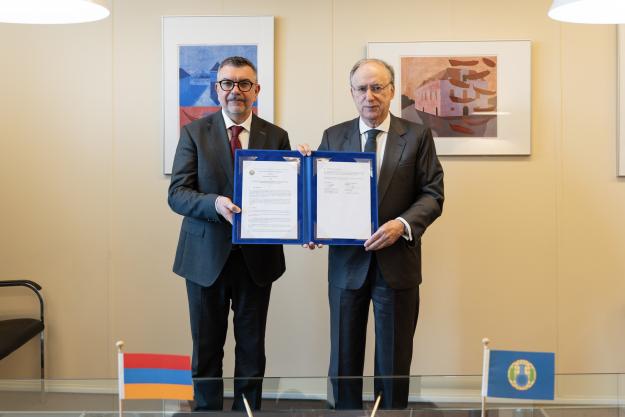
Permanent Representative of the Republic of Armenia to the OPCW, H.E. Mr Viktor Biyagov, and the OPCW Director-General, Ambassador Fernando Arias
THE HAGUE, Netherlands—20 May 2026— The Government of the Republic of Armenia has voluntarily contributed EUR 10,000 to the Trust Fund for Training and the Trust Fund for Syria Missions.
Armenia’s voluntary contribution of EUR 5,000 will support a joint “Workshop on Policy and Diplomacy for scientists 2026” co-hosted by the OPCW Technical Secretariat and the Biological Weapons Convention (BWC) Implementation Support Unit. The programme is primarily designed for young scientists who hold a PhD in natural sciences or a related field, from Member States with economies that are developing or in transition. The workshop will cover policy, diplomacy, scientific advances, and cross-cutting issues related to the Chemical Weapons Convention (CWC) and the BWC and will foster dialogue on the role of scientists in implementing these treaties and the challenges involved.
An additional voluntary contribution of EUR 5,000 will support Syria-related missions and activities carried out by the OPCW Technical Secretariat to implement its mandate. Its objectives include establishing the full scope of Syria’s chemical weapons programme, verifying all declarable elements, supporting the development and implementation of a destruction plan, and investigating allegations of chemical weapons use, including the identification of those responsible.
The voluntary contribution was formalised on 12 May 2026 in a signing ceremony held between the Ambassador, Permanent Representative of Armenia to the OPCW, H.E. Mr Viktor Biyagov, and the OPCW Director-General, Ambassador Fernando Arias, at the Organisation’s Headquarters in The Hague.
Ambassador Biyagov stated: “Armenia’s contributions in these areas reflect a deep understanding of the importance of the activities carried out by the OPCW Centre for Chemistry and Technology (the ChemTech Centre), as well as support for the OPCW Technical Secretariat’s efforts in relation to Syria.”
Director-General Arias stated: “I wish to thank Armenia for its steadfast support for the Technical Secretariat’s work in fulfilling its mandate. With the concrete support of our Member States, including Armenia’s contribution today, the ChemTech Centre will be able to further realise its full potential and enhance its capacity-building activities for the benefit of all Member States. The Secretariat will also be better positioned to support Syria in fulfilling its obligations under the Convention.”
Background
Armenia has been an active member of the OPCW since the Chemical Weapons Convention entered into force in 1997.
The “Workshop on Policy and Diplomacy for scientists 2026” will provide a forum for young scientists to learn about the role of science in fostering global peace and security, with a focus on disarmament and non-proliferation. It will cover seven key areas, including the role of science diplomacy, the chemistry-biology convergence in Chemical Weapons Convention (CWC) and Biological Weapons Convention (BWC), and the ethical challenges posed by emerging technologies such as artificial intelligence in the chemical and biotechnology sectors.
The fall of the Assad government in December 2024 created an opportunity to uncover the full scope of Syria’s chemical weapons programme and to eliminate it in line with the Chemical Weapons Convention (CWC). In February 2025, the OPCW Director-General visited Syria and held separate meetings with the Syrian President and Foreign Minister. They expressed Syria’s recognition of all OPCW mandates, including the identification of perpetrators of chemical weapons use in Syria and reaffirmed Syria’s full commitment to fulfilling its obligations under the CWC. In March 2025, the Syrian Foreign Minister visited the OPCW and addressed the Executive Council, where he renewed Syria’s commitment to the Convention.
Since the visit by the Director-General to Damascus in February 2025, the OPCW Technical Secretariat deployed several times to Syria, involving visits to suspected locations, sampling, interviews, collection of documents related to Syria’s chemical weapons programme, and coordination.
As the implementing body for the Chemical Weapons Convention, the OPCW, with its 193 Member States, oversees the global endeavour to permanently eliminate chemical weapons. Since the Convention’s entry into force in 1997, it is the most successful disarmament treaty eliminating an entire class of weapons of mass destruction.
In 2023, the OPCW verified that all chemical weapons stockpiles declared by the 193 States Parties to the Chemical Weapons Convention since 1997 — totalling 72,304 metric tonnes of chemical agents — have been irreversibly destroyed under the OPCW’s strict verification regime.
For its extensive efforts in eliminating chemical weapons, the OPCW received the 2013 Nobel Peace Prize.