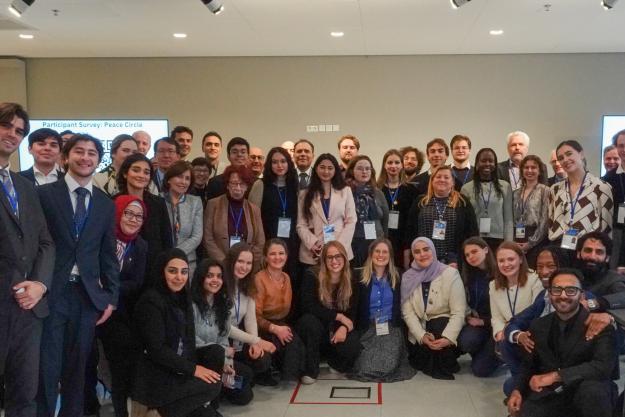
OPCW organised the side event “Youth-Led Peace Circle: Intergenerational Dialogue on Disarmament, Chemistry for Peace and the Future of the Chemical Weapons Convention” during the CSP-30 on 25 November 2025.
THE HAGUE, Netherlands—13 May 2026—The Organisation for the Prohibition of Chemical Weapons (OPCW) continues to strengthen its engagement with young people through a range of educational, dialogue-based, and multilateral simulation initiatives designed to deepen awareness of chemical weapons disarmament and the Chemical Weapons Convention (CWC).
In recent months, young people from around the world have participated in these initiatives through programmes supported by the OPCW. From multilateral negotiations in New York to engaging directly with disarmament experts in the Hague, these experiences opened new platforms for civil society to shape dialogue on global security.
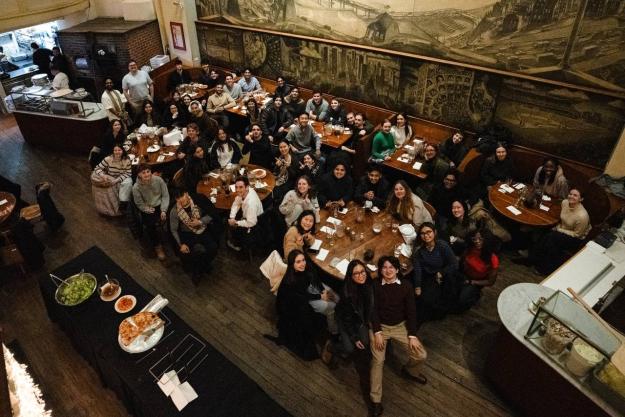
Delegates taking part in the OPCW Model UN simulation organised in cooperation with the World Federation of United Nations Associations (WFUNA) during WIMUN New York 2026 gather for a group social event in February 2026.
Supporting youth participation through multilateral simulations
From 9–13 February 2026, the OPCW partnered with the World Federation of United Nations Associations (WFUNA) to simulate the OPCW’s work at WIMUN New York — marking the first time the OPCW has been represented in a model UN setting. 58 students from 19 countries took on the roles of diplomats negotiating, debating and working toward consensus under the same constraints faced by real-world delegates, with many engaging with the field of chemical weapons prohibition and elimination for the first time.
“Simulating the OPCW allows students to engage with one of the most technically demanding and norm-driven bodies of the UN system,” said Bill Yotive, WFUNA’s Senior Education Officer. “It teaches them that disarmament is not only a legal commitment, but a continuous process of verification, scientific expertise, and collective responsibility.”
To ensure authenticity, OPCW staff helped develop a study guide, annotated bibliography, and procedural tools mirroring the Organisation’s complex decision-making process.
“Despite the divergent politics of our turbulent times, our simulation achieved consensus,” said Riddhi Sen Majumder, Chair of the session. “It showed just how interdisciplinary multilateral cooperation truly is.”
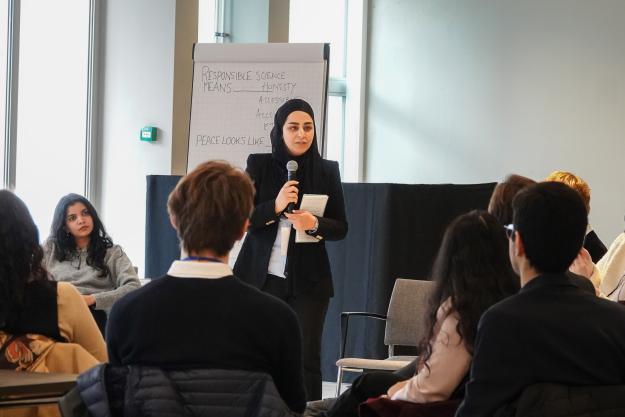
OPCW organised the side event “Youth-Led Peace Circle: Intergenerational Dialogue on Disarmament, Chemistry for Peace and the Future of the Chemical Weapons Convention” during the CSP-30 on 25 November 2025.
Facilitating dialogue with youth and civil society at CSP-30
At CSP-30, young professionals and experts sat side by side as youth engagement took centre stage with the Peace Circle—an intergenerational dialogue hosted by the OPCW Technical Secretariat and youth-led civil society networks. Co-sponsored by Australia, Costa Rica, Indonesia, Ireland, Mexico, Türkiye, and the Republic of Korea, the initiative supported the UN campaign “Hear Us, Act Now for a Peaceful World.”
Young professionals, students, and experts held a youth-led discussion on disarmament, responsible science, and the prevention of chemical weapons re-emergence, reflecting on the historical use and impact of chemical weapons, in the importance of acknowledging harm done to the victims, and the shared responsibility of upholding the CWC.
Participating groups included the European Youth Parliament (EYP), African Center for Science and International Security, Inc., VERTIC, Chemicals & Waste Youth Platform (UN MGCY), and the Organisation for Defending Sardasht Victims of Chemical Weapons.
Engaging European youth on peace and security
In April 2025, the OPCW partnered with the European Youth Parliament (EYP), with EU support, for a major session in The Hague that brought together over 200 young delegates to debate global challenges under the theme “Young visions of Peace and Security.”
“Being born into a time where peace is the norm is an immense privilege — but if we don’t actively understand the risks that threaten it, we risk losing it,” said Lenka Živanović, Chairperson of the Committee on Security and Defence II.
The OPCW contributed expert briefings, hosted a visit to its Headquarters, and supported a session on chemical weapons non-proliferation. Discussions covered national implementation of the CWC, emerging technologies, disinformation, and verification. Among the outcomes, a resolution calling for stronger international frameworks to prevent chemical weapons proliferation was adopted — evidence of how youth engagement can translate into concrete policy thinking.
“Young voices matter,” said Irish delegate Aisha Ní hAnainn Ní Bhaoill. “Exploring real flaws and solutions in the CWC made our committee work feel truly impactful.”
Benjamin Glover (UK) added, “International organisations have much to teach — but also much to learn from youth who are shaping the future.”
Živanović concluded: “It’s a powerful model of intergenerational exchange — one where both institutions and youth can learn from each other to build a fairer world.”
Looking ahead
Youth engagement is central to the OPCW’s mission to ensure the long-term relevance and resilience of the Chemical Weapons Convention. By investing in education, dialogue, and practical learning, the Organisation is equipping future leaders with the knowledge and responsibility to uphold disarmament norms in a changing world.
These efforts reflect a broader strategic goal: embedding disarmament values across generations. As young participants continue to engage, innovate, and lead, their contributions will be vital in strengthening international cooperation and preventing the re-emergence of chemical weapons.
Background
As the implementing body for the Chemical Weapons Convention, the OPCW, with its 193 Member States, oversees the global endeavour to permanently eliminate chemical weapons. Since the Convention’s entry into force in 1997, it is the most successful disarmament treaty eliminating an entire class of weapons of mass destruction.
In 2023, the OPCW verified that all chemical weapons stockpiles declared by the 193 States Parties to the Chemical Weapons Convention since 1997 — totalling 72,304 metric tonnes of chemical agents — have been irreversibly destroyed under the OPCW’s strict verification regime.
For its extensive efforts in eliminating chemical weapons, the OPCW received the 2013 Nobel Peace Prize.