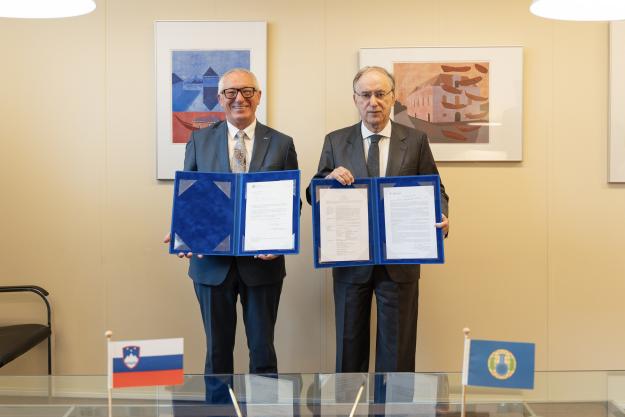
Permanent Representative of Slovenia to the OPCW, H.E. Mr Jožef Drofenik, and the OPCW Director-General, Ambassador Fernando Arias
THE HAGUE, Netherlands—20 May 2026— The Government of the Republic of Slovenia has voluntarily contributed EUR 50,000 to the Trust Fund for Syria Missions and the Trust Fund for the Implementation of Article X.
Slovenia’s voluntary contribution of EUR 30,000 will support Syria-related missions and activities carried out by the OPCW Technical Secretariat to implement its mandate. Its objectives include establishing the full scope of Syria’s chemical weapons programme, verifying all declarable elements, supporting the development and implementation of a destruction plan, and investigating allegations of chemical weapons use, including the identification of those responsible.
An additional voluntary contribution of EUR 20,000 will support ongoing Assistance and Protection programmes earmarked for activities related to Ukraine.
The voluntary contribution was formalised on 12 May 2026 in a signing ceremony held between the Ambassador, Permanent Representative of Slovenia to the OPCW, H.E. Mr Jožef Drofenik, and the OPCW Director-General, Ambassador Fernando Arias, at the Organisation’s Headquarters in The Hague.
Ambassador Drofenik stated: “The ceremony today coincides with the commencement of Slovenia’s membership on the Executive Council. On this occasion, I wish to emphasise my country’s commitment to multilateralism, international law, and international cooperation, particularly in pursuit of our shared goal of a world free of chemical weapons.”
Director-General Arias stated: “I sincerely appreciate Slovenia’s support for the Technical Secretariat in carrying out its mandate. The Syrian and Ukrainian dossiers continue to be of particular relevance to the Secretariat. With the active support of our Member States, including Slovenia’s contribution today, the Secretariat will be better positioned to support Syria in meeting its obligations under the Convention. The Secretariat will also continue to extend support to Ukraine, upon its request, in line with its mandate.”
Background
Slovenia has been an active member of the OPCW since the Chemical Weapons Convention entered into force in 1997. Slovenia was elected to the Executive Council by the Conference of the States Parties in November 2025 and will serve a two-year term commencing on 12 May 2026.
To date, Slovenia has contributed a total of more than EUR 72, 000 to OPCW’s trust funds, including the Trust Fund for a Centre for Chemistry and Technology.
The fall of the Assad government in December 2024 created an opportunity to uncover the full scope of Syria’s chemical weapons programme and to eliminate it in line with the Chemical Weapons Convention (CWC). In February 2025, the OPCW Director-General visited Syria and held separate meetings with the Syrian President and Foreign Minister. They expressed Syria’s recognition of all OPCW mandates, including the identification of perpetrators of chemical weapons use in Syria and reaffirmed Syria’s full commitment to fulfilling its obligations under the CWC. In March 2025, the Syrian Foreign Minister visited the OPCW and addressed the Executive Council, where he renewed Syria’s commitment to the Convention.
Since the visit by the Director-General to Damascus in February 2025, the OPCW Technical Secretariat deployed several times to Syria, involving visits to suspected locations, sampling, interviews, collection of documents related to Syria’s chemical weapons programme, and coordination.
The OPCW Technical Secretariat has been monitoring the situation on the territory of Ukraine since the start of the war in February 2022 in relation to allegations of use of toxic chemicals as weapons.
In 2024 and 2025, the Technical Secretariat conducted three Technical Assistance Visits (TAVs) to Ukraine upon Ukraine’s request. The reports of all three TAVs confirmed that the samples collected by Ukraine on the battlefield contained the toxic chemical 2-Chlorobenzylidenemalononitrile, known as CS. The Convention explicitly prohibits the use of riot control agents as a weapon of war on the battlefield.
Article X of the Chemical Weapons Convention (CWC) provides for assistance and protection to a State Party if it is attacked or threatened by chemical weapons. Through the relevant Trust Fund, the OPCW Technical Secretariat has provided support to Ukraine, upon its request, to strengthen its preparedness and response capabilities against chemical weapons threats. These efforts included deployment of the Technical Assistance Visits, provision of protective, detection, and identification equipment and training Ukrainian first responders and experts.
As the implementing body for the Chemical Weapons Convention, the OPCW, with its 193 Member States, oversees the global endeavour to permanently eliminate chemical weapons. Since the Convention’s entry into force in 1997, it is the most successful disarmament treaty eliminating an entire class of weapons of mass destruction.
In 2023, the OPCW verified that all chemical weapons stockpiles declared by the 193 States Parties to the Chemical Weapons Convention since 1997 — totalling 72,304 metric tonnes of chemical agents — have been irreversibly destroyed under the OPCW’s strict verification regime.
For its extensive efforts in eliminating chemical weapons, the OPCW received the 2013 Nobel Peace Prize.