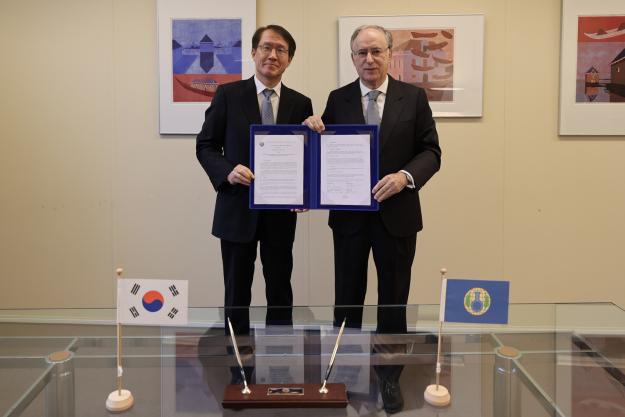
Permanent Representative of the Republic of Korea, H.E. Ambassador Seok-in Hong and OPCW Director-General, Ambassador Fernando Arias
THE HAGUE, Netherlands—9 March 2026— The Government of the Republic of Korea has contributed €83,000 to the Trust Fund for Syria Missions and the Trust Fund for Regional Seminars of the Organisation for the Prohibition of Chemical Weapons (OPCW).
One part of the voluntary contribution, €48,000, will support Syria-related missions and activities carried out by the OPCW Technical Secretariat. Its objectives include establishing the full scope of Syria’s chemical weapons programme, verifying all declarable elements, supporting the development and implementation of a destruction plan, and investigating allegations of chemical weapons use, including the identification of those responsible.
The rest of the contribution (€35,000) will support the organisation of the 15th Workshop on the Peaceful Development and Use of Chemistry, to be held in Seoul, Republic of Korea, in 2026. The three-day workshop will promote the peaceful application of chemistry for the economic and technological advancement of OPCW Member States by strengthening national capacities and fostering cooperation in line with Article XI of the Convention. It will bring together participants to enhance chemical safety and security management practices in Asia, explore developments in AI and its applications in chemical research and industry, and share practical examples from the Republic of Korea on how AI can improve safety and security in the chemical sector.
The voluntary contribution was formalised on 26 February 2026 in a signing ceremony held between the Ambassador, Permanent Representative of the Republic of Korea to the OPCW, H.E. Mr Seok-in Hong, and the OPCW Director-General, Ambassador Fernando Arias, at the OPCW’s Headquarters in The Hague.
Ambassador Hong said: “The Government of the Republic of Korea is pleased to make a contribution of €83,000 to the OPCW Syria Trust Fund and the Seoul Workshop. As a country with a significant chemical industry, Korea has consistently supported the OPCW and will continue to actively support the work of the Technical Secretariat going forward.”
Director-General Arias welcomed the contribution, noting: “I thank the Republic of Korea for its generous voluntary contribution, which will support our efforts to clarify the full scope of Syria’s chemical weapons programme, verify declarable elements, advance destruction planning, and investigate allegations of use, including the identification of those responsible.”
“At the same time, the Republic of Korea’s contribution to the 15th Workshop on the Peaceful Development and Use of Chemistry in Seoul in 2026 highlights its strong commitment to promoting international cooperation, enhancing chemical safety and security in the Asia region, and advancing the responsible application of emerging technologies such as artificial intelligence in the chemical sector,” he highlighted.
Background
The Republic of Korea has been an active member of the OPCW since the Chemical Weapons Convention entered into force in 1997 and is a member of the OPCW Executive Council, the governing body of the Organisation.
To date, the Republic of Korea has contributed over €3.6 million to various OPCW trust funds, including the Trust Fund for a Centre for Chemistry and Technology, the Trust Fund for Regional Seminars, the Trust Fund for the Junior Professional Officers Programme, and the Trust Fund for Training.
Syria acceded to the Chemical Weapons Convention (CWC) in 2013 under a stringent verification regime. While Syria submitted an initial declaration of its chemical weapons (CW) programme, the former Syrian government did not declare all its CW programme and attempted – unsuccessfully – to mislead the international community about the overall scope and scale of the Syrian chemical weapons programme. Furthermore, the Technical Secretariat documented and independently confirmed chemical weapons use in Syria both by the former Syrian military forces and by non-state actors, specifically ISIS/ISIL.
The fall of the Assad government in December 2024 created an opportunity to uncover the full scope of Syria’s chemical weapons programme and to eliminate it in line with the CWC. In February 2025, the OPCW Director-General visited Syria and held separate meetings with the Syrian President and Foreign Minister. They expressed Syria’s recognition of all OPCW mandates, including the identification of perpetrators of chemical weapons use in Syria and reaffirmed Syria’s full commitment to fulfilling its obligations under the CWC. In March 2025, the Syrian Foreign Minister visited the OPCW and addressed the Executive Council, where he renewed Syria’s commitment to the Convention.
Since the visit by the Director-General to Damascus in February 2025, the OPCW Technical Secretariat deployed several times to Syria, involving visits to suspected locations, sampling, interviews, collection of documents related to Syria’s chemical weapons programme, and coordination.
Since November 2025, OPCW has re-established a continuous presence in Syria to facilitate upcoming inventory, destruction and verification-related activities. The work related to the Syrian chemical weapons dossier – verification of declarations and investigation of use of toxic chemicals as weapons – is now coordinated by the OPCW Office of Special Missions.
As the implementing body for the Chemical Weapons Convention, the OPCW, with its 193 Member States, oversees the global endeavour to permanently eliminate chemical weapons. Since the Convention’s entry into force in 1997, it is the most successful disarmament treaty eliminating an entire class of weapons of mass destruction.
In 2023, the OPCW verified that all chemical weapons stockpiles declared by the 193 States Parties to the Chemical Weapons Convention since 1997 — totalling 72,304 metric tonnes of chemical agents — have been irreversibly destroyed under the OPCW’s strict verification regime.
For its extensive efforts in eliminating chemical weapons, the OPCW received the 2013 Nobel Peace Prize.