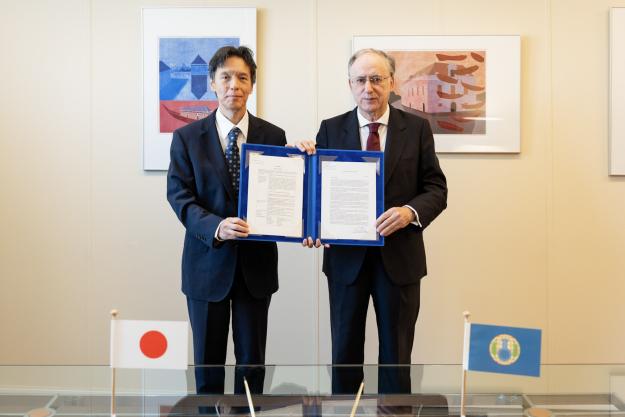
Permanent Representative of Japan to the OPCW, H.E. Mr Rokuichiro Michii and OPCW Director-General, Ambassador Fernando Arias
THE HAGUE, Netherlands—9 March 2026— The Government of Japan has voluntarily contributed nearly €200,000 to two trust funds of the Organisation for the Prohibition of Chemical Weapons (OPCW): the Trust Fund for Syria Missions and the Trust Fund for the Implementation of Article X (Ukraine).
Part of the contribution will support Syria-related missions and activities carried out by the OPCW Technical Secretariat. Its objectives include establishing the full scope of Syria’s chemical weapons programme, verifying all declarable elements, supporting the development and implementation of a destruction plan, and investigating allegations of chemical weapons use, including the identification of those responsible.
The funding allocated to the Trust Fund for the Implementation of Article X will be used to facilitate the provision of equipment, training, expertise, logistical support and further technical assistance to enhance Ukraine’s resilience against chemical weapons threats.
The voluntary contribution was formalised on 5 March 2026 in a signing ceremony held between the Ambassador, Permanent Representative of Japan to the OPCW, H.E. Mr Rokuichiro Michii, and the OPCW Director-General, Ambassador Fernando Arias, at the Organisation’s Headquarters in The Hague.
“Japan is proud to contribute to these important initiatives and looks forward to continuing our close collaboration with the OPCW in pursuit of peace, security, and the complete elimination of chemical weapons,” said Ambassador Michii.
“We are fully aware that the success of these efforts depends not only on financial resources but equally on steadfast political will and international cooperation. Japan remains committed to working closely with the OPCW, States Parties, and all relevant stakeholders to ensure the successful implementation of these projects and to advance the broader goals of the Chemical Weapons Convention,” he underlined.
Director-General Arias stated: “I thank Japan for its timely support to the Technical Secretariat’s activities related to Syria and for strengthening the Trust Fund for the Implementation of Article X in support of Ukraine. These contributions help ensure that the OPCW can continue its vital work to support States Parties, enhance preparedness, and uphold the global norm against chemical weapons.”
Background
Japan joined the Chemical Weapons Convention in 1995 and is currently a member of the OPCW Executive Council.
To date, Japan has contributed a total of more than EUR 17,450 to 14 different OPCW trust funds, including: the Trust Fund for a Centre for Chemistry and Technology, the Trust Fund for Junior Professionals, the Trust Fund for the Implementation of Article X, in support for Ukraine.
Article X of the Chemical Weapons Convention (CWC) provides for assistance and protection to a State Party if it is attacked or threatened by chemical weapons. Through the relevant Trust Fund, the OPCW Technical Secretariat has provided support to Ukraine, upon its request, to strengthen its preparedness and response capabilities against chemical weapons threats. These efforts included deployment of the Technical Assistance Visits, provision of protective, detection, and identification equipment and training Ukrainian first responders and experts.
Syria acceded to the Chemical Weapons Convention (CWC) in 2013 under a stringent verification regime. While Syria submitted an initial declaration of its chemical weapons (CW) programme, the former Syrian government did not declare all its CW programme and attempted – unsuccessfully – to mislead the international community about the overall scope and scale of the Syrian chemical weapons programme. Furthermore, the Technical Secretariat documented and independently confirmed chemical weapons use in Syria both by the former Syrian military forces and by non-state actors, specifically ISIS/ISIL.
The fall of the Assad government in December 2024 created an opportunity to uncover the full scope of Syria’s chemical weapons programme and to eliminate it in line with the CWC. In February 2025, the OPCW Director-General visited Syria and held separate meetings with the Syrian President and Foreign Minister. They expressed Syria’s recognition of all OPCW mandates, including the identification of perpetrators of chemical weapons use in Syria and reaffirmed Syria’s full commitment to fulfilling its obligations under the CWC. In March 2025, the Syrian Foreign Minister visited the OPCW and addressed the Executive Council, where he renewed Syria’s commitment to the Convention.
Since the visit by the Director-General to Damascus in February 2025, the OPCW Technical Secretariat deployed several times to Syria, involving visits to suspected locations, sampling, interviews, collection of documents related to Syria’s chemical weapons programme, and coordination.
Since November 2025, OPCW has re-established a continuous presence in Syria to facilitate upcoming inventory, destruction and verification-related activities. The work related to the Syrian chemical weapons dossier – verification of declarations and investigation of use of toxic chemicals as weapons – is now coordinated by the OPCW Office of Special Missions.
As the implementing body for the Chemical Weapons Convention, the OPCW, with its 193 Member States, oversees the global endeavour to permanently eliminate chemical weapons. Since the Convention’s entry into force in 1997, it is the most successful disarmament treaty eliminating an entire class of weapons of mass destruction.
In 2023, the OPCW verified that all chemical weapons stockpiles declared by the 193 States Parties to the Chemical Weapons Convention since 1997 — totalling 72,304 metric tonnes of chemical agents — have been irreversibly destroyed under the OPCW’s strict verification regime.
For its extensive efforts in eliminating chemical weapons, the OPCW received the 2013 Nobel Peace Prize.