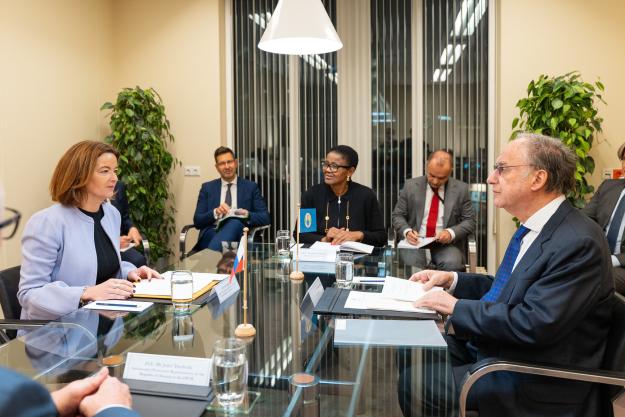
H.E. Ms Tanja Fajon, Deputy Prime Minister and Minister of Foreign and European Affairs of the Republic of Slovenia, and Ambassador Fernando Arias, OPCW Director-General, and their delegations.
THE HAGUE, Netherlands—19 December 2025—The Director-General of the Organisation for the Prohibition of Chemical Weapons (OPCW), Ambassador Fernando Arias, met with the Deputy Prime Minister and Minister of Foreign and European Affairs of the Republic of Slovenia, H.E. Ms Tanja Fajon, on 1 December at the OPCW’s Headquarters in The Hague.
The meeting centred on major issues related to implementing the Chemical Weapons Convention (CWC), with both leaders exchanging views on the recently concluded Thirtieth Session of the Conference of the States Parties (CSP). Director-General Arias underscored that “The confirmed use of chemical weapons and the increasing number of allegations discussed during the CSP demonstrates that the OPCW’s mission is far from accomplished.”
The Deputy Prime Minister affirmed Slovenia’s active and constructive engagement as a newly elected member of the OPCW Executive Council (2026–2028), with a strong emphasis on multilateralism, international law, and the experience Slovenia has gained as a non-permanent member of the UN Security Council.
Director-General Arias expressed his sincere appreciation for Slovenia’s longstanding support of the Organisation, adding: “Slovenia’s new membership on the Executive Council offers another opportunity to further strengthen our cooperation.”
The Director-General provided an update on the OPCW’s ongoing activities in Ukraine. He reiterated his deep concern over the findings of the technical assistance visits (TAVs) to Ukraine, which confirmed the presence of CS, a riot control agent that the Convention prohibits to be used as a method of warfare, along the frontlines. He also stated: “Alongside the TAVs, the Secretariat has continued to deliver support to Ukraine, upon its request, in the field of assistance and protection, under Article X of the Convention. For instance, training courses on emergency response to incidents involving toxic chemicals, as well as on sampling for investigations of chemical weapons use, have been delivered to Ukrainian experts. The Secretariat’s engagement exemplifies how its expertise can be deployed to build and strengthen national capacity in case of chemical incidents, including investigations.”
The Director-General also briefed the Deputy Prime Minister on the OPCW’s latest activities in Syria. He stated that “The Technical Secretariat faces the daunting task of assisting the new Syrian authorities in establishing the full scope of the chemical weapons programme and associated responsibilities that they have inherited. Despite the complexity of the task, the OPCW continues to engage with the new Syrian government and our States Parties, and the Technical Secretariat’s deployments to Syria are ongoing.”
Background
Slovenia has been an active member of the OPCW since 1997. On 25 November 2025, the Thirtieth Session of the Conference of the States Parties elected Slovenia, from the Eastern European Group, to serve on the Executive Council for a term of two years, starting on 12 May 2026.
The OPCW Executive Council consists of 41 OPCW Member States that are elected by the Conference of the States Parties and rotate every two years.
As the implementing body for the Chemical Weapons Convention, the OPCW, with its 193 Member States, oversees the global endeavour to permanently eliminate chemical weapons. Since the Convention’s entry into force in 1997, it is the most successful disarmament treaty eliminating an entire class of weapons of mass destruction.
In 2023, the OPCW verified that all chemical weapons stockpiles declared by the 193 States Parties to the Chemical Weapons Convention since 1997 — totalling 72,304 metric tonnes of chemical agents — have been irreversibly destroyed under the OPCW’s strict verification regime.
For its extensive efforts in eliminating chemical weapons, the OPCW received the 2013 Nobel Peace Prize.