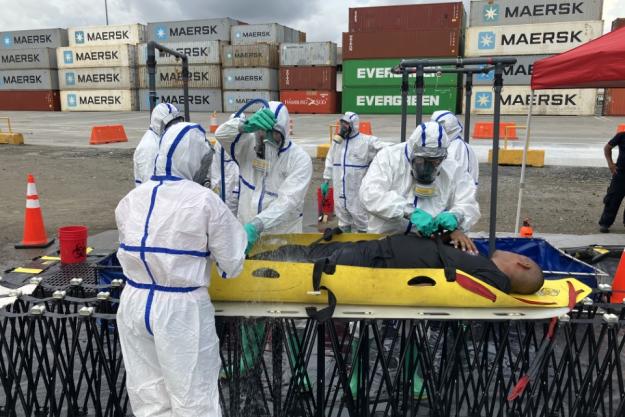
Participants conduct victim decontamination procedures during the final exercise of the Integrated Advanced Course and Exercise for GRULAC in Panama.
THE HAGUE, Netherlands- 19 December 2025- The Organisation for the Prohibition of Chemical Weapons (OPCW), in collaboration with the Governments of Panama, Malaysia, Tunisia, and Pakistan, successfully concluded four hybrid integrated advanced training sessions designed to enhance chemical emergency preparedness among OPCW Member States in different regions.
Building on lessons learned from a pilot integrated advanced course and exercise held in Ecuador in 2024, the 2025 series of training were delivered across Africa, Asia, Latin America, and the Caribbean, as well as at the international level. The series supported countries in strengthening national response plans for chemical emergencies, improving operational readiness, and reinforcing regional cooperation through cross-border collaboration and shared expertise.
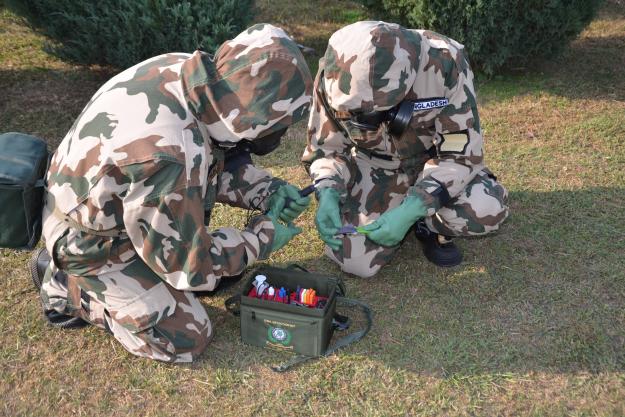
Participants conduct detection, identification and monitoring activities during a chemical emergency response exercise held as part of a training course in Islamabad, Pakistan.
Several participating countries have already begun integrating OPCW methodologies and tools into their national emergency response frameworks, reflecting the practical application of the training outcomes.
Each training combined online learning, in-person drills, and follow-up coaching to maximise knowledge retention and practical application in real-world emergency planning. The programme for the training was structured around three key components: an online course covering the fundamental concepts and key considerations to respond to chemical incidents; an integrated advanced course and exercise delivered through in-person sessions hosted in Panama City, Kuala Lumpur, Menzel Jemil, and Islamabad; and a follow-up webinar focused on applying newly acquired skills at the national level.
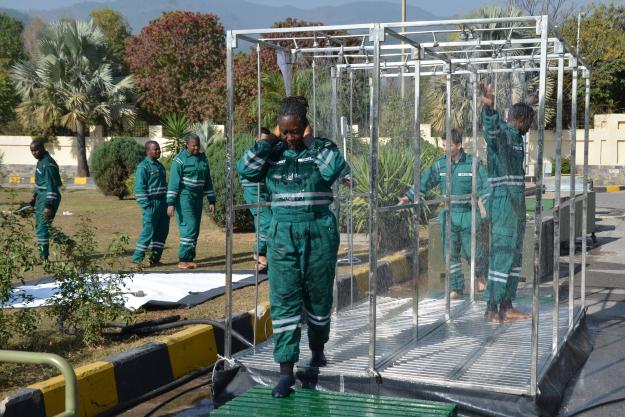
Participants conduct decontamination procedures during the International Integrated Advanced Course and Exercise on Assistance and Protection, held from 4 to 11 November 2025 in Islamabad, Pakistan.
A total of 89 experts from 47 OPCW Member States benefitted from the series. The in-person training sessions featured a diverse array of practical demonstrations, real-time scenarios, tabletop and field exercises, designed to enhance operational readiness and technical proficiency. Each training covered decontamination procedures, including doffing and donning of personal protective equipment; reconnaissance; sampling and analysis in contaminated environments; detection, identification, and monitoring; hot zone management; incident command scenarios; and a final capstone exercise.
Beyond technical capacity-building, these integrated advanced course and exercise training sessions fostered professional exchange and strengthened cooperation among participating countries. By bringing together practitioners from different regions and institutional backgrounds, the programme supported the development of professional networks and encouraged information-sharing, knowledge transfer and coordination for potential joint responses to chemical emergencies.
Background
Article X of the Chemical Weapons Convention outlines the rights of Member States to request assistance when threatened or attacked with chemical weapons and encourages nations to share technologies and resources for protecting civilians and personnel.
Through its integrated and multi-regional approach, the OPCW’s International Cooperation and Assistance Programme continues to support Member States in fulfilling their obligations under Article X of CWC in strengthening collective capacity to prevent and respond to chemical threats.
As the implementing body for the Chemical Weapons Convention, the OPCW, with its 193 Member States, oversees the global endeavour to permanently eliminate chemical weapons. Since the Convention’s entry into force in 1997, it is the most successful disarmament treaty eliminating an entire class of weapons of mass destruction.
In 2023, the OPCW verified that all chemical weapons stockpiles declared by the 193 States Parties to the Chemical Weapons Convention since 1997 — totalling 72,304 metric tonnes of chemical agents — have been irreversibly destroyed under the OPCW’s strict verification regime.
For its extensive efforts in eliminating chemical weapons, the OPCW received the 2013 Nobel Peace Prize.