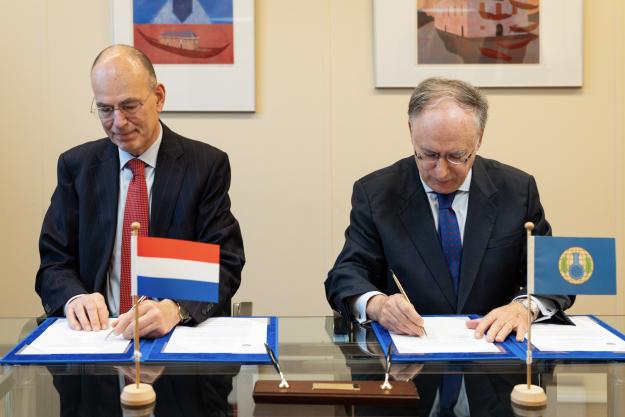
Permanent Representative of the Kingdom of the Netherlands to the OPCW, Ambassador Govert Jan Cornelis Bijl de Vroe, and the OPCW Director-General, Ambassador Fernando Arias.
THE HAGUE, Netherlands—22 December 2025—The Government of the Kingdom of the Netherlands has voluntarily contributed €500,000 to the Trust Fund for Syria Missions of the Organisation for the Prohibition of Chemical Weapons (OPCW).
The voluntary contribution was formalised on 18 December 2025 in a signing ceremony held between the Ambassador, Permanent Representative of the Kingdom of the Netherlands to the OPCW, H.E. Mr Govert Jan Cornelis Bijl de Vroe, and the OPCW Director-General, Ambassador Fernando Arias, at the Organisation’s Headquarters in The Hague.
Ambassador Bijl de Vroe stated: “It is encouraging to see that the Netherlands is in good company among a number of States Parties making a voluntary contribution to the Trust Fund for Syria Missions towards the end of this year. It clearly demonstrates the importance of the OPCW’s work in Syria to eliminate the remnants of the Assad regime’s chemical weapons programme once and for all.”
The Director-General expressed his sincere gratitude to the Netherlands for the contribution. He stated: “This contribution, together with other practical support provided by the Netherlands as host country to the OPCW, demonstrates again its strong dedication to upholding the norms and principles of the Chemical Weapons Convention (CWC).”
“This contribution comes at an important moment. The Syrian chemical weapons dossier has been lingering for 12 years. The endeavour to close the Syrian chemical weapons dossier is at the core of the CWC and the work of the OPCW, and substantively contributes to peace and international security. This is a multilateral effort requiring the broad support of the OPCW Member States and the international community at large,” he added.
The Netherlands’ contribution will support OPCW’s missions and activities to determine the full scope of Syria’s chemical weapons programme, and investigation of alleged chemical weapons use and identification of perpetrators of their use in the Syrian Arab Republic.
Background
The Netherlands has been an active member of the OPCW since 1997. In the Subsidiary Bodies, it is represented in the Confidentiality Commission.
To date, the Netherlands has contributed a total of more than EUR 8.99 million to 16 OPCW Trust Funds. Since 2023, the Netherlands has made voluntary contributions to the Trust Fund Implementation of Article X earmarked for Ukraine, the Trust Fund for the OPCW Conference of the States Parties and Special Sessions Meetings, the Trust Fund for Syria Missions, the Trust Fund for OPCW Nobel Prize, and the Trust for the International NGO Coalition Against Chemical Weapons.
Syria acceded to the Chemical Weapons Convention (CWC) in 2013 under a stringent verification regime. While Syria submitted an initial declaration of its chemical weapons (CW) programme, the former Syrian government did not declare all its CW programme and attempted – unsuccessfully – to mislead the international community about the overall scope and scale of the Syrian chemical weapons programme. Furthermore, the Technical Secretariat documented and independently confirmed chemical weapons use in Syria both by the former Syrian military forces and by non-state actors, specifically ISIS/ISIL.
The fall of the Assad government in December 2024 created an opportunity to uncover the full scope of Syria’s chemical weapons programme and to eliminate it in line with the CWC. In February 2025, the OPCW Director-General visited Syria and held separate meetings with the Syrian President and Foreign Minister. They expressed Syria’s recognition of all OPCW mandates, including the identification of perpetrators of chemical weapons use in Syria and reaffirmed Syria’s full commitment to fulfilling its obligations under the CWC. In March 2025, the Syrian Foreign Minister visited the OPCW and addressed the Executive Council, where he renewed Syria’s commitment to the Convention.
Since the visit by the Director-General to Damascus in February 2025, the OPCW Technical Secretariat deployed several times to Syria, involving visits to suspected locations, sampling, interviews, collection of documents related to Syria’s chemical weapons programme, and coordination.
As the implementing body for the Chemical Weapons Convention, the OPCW, with its 193 Member States, oversees the global endeavour to permanently eliminate chemical weapons. Since the Convention’s entry into force in 1997, it is the most successful disarmament treaty eliminating an entire class of weapons of mass destruction.
In 2023, the OPCW verified that all chemical weapons stockpiles declared by the 193 States Parties to the Chemical Weapons Convention since 1997 — totalling 72,304 metric tonnes of chemical agents — have been irreversibly destroyed under the OPCW’s strict verification regime.
For its extensive efforts in eliminating chemical weapons, the OPCW received the 2013 Nobel Peace Prize.