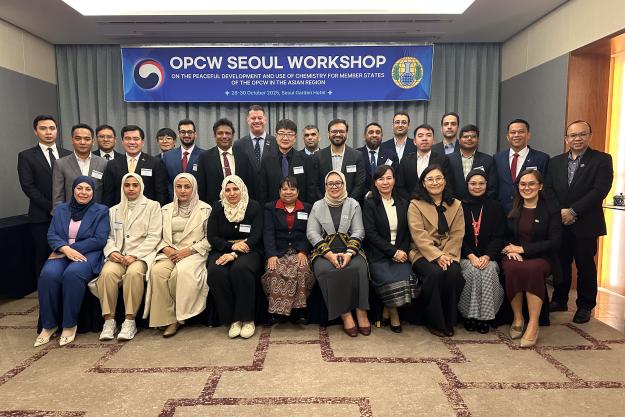
THE HAGUE, Netherlands – 3 November 2025 – The Organisation for the Prohibition of Chemical Weapons (OPCW) and the Republic of Korea organised the 14th edition of the Seoul Workshop on the Peaceful Development and Use of Chemistry for OPCW Member States in the Asian region from 28 to 30 October 2025 in Seoul, Republic of Korea.
Asia hosts the world’s largest regional chemical industry. The workshop brought together government officials, representatives of chemical industry associations, and managers and professionals in chemistry and chemical engineering from across Asia to further strengthen relevant national capacities and to promote the peaceful application of chemistry in the region.
Aligned with Article XI of the Chemical Weapons Convention (CWC), the workshop featured expert-led sessions and provided a platform for the exchange of best practices in chemical safety and security management across the Asia region. It addressed a range of topics, including the peaceful applications of dual-use chemicals, chemical supply chain security, and chemical emergency management, among others.
During the workshop, Korean experts shared their experiences and expertise in toxic chemicals management and stepwise chemical safety management, while OPCW experts presented the Organisation’s Indicative Guidelines for Safe and Secure Transport of Hazardous Chemicals by Road. The workshop also addressed the application of artificial intelligence in the chemical industry, as well as its implication on the implementation of the CWC.
At the opening of the event, Ms Jiyoung Yun, Director of the Disarmament and Non-proliferation Division at the Ministry of Foreign Affairs of the Republic of Korea, expressed her appreciation for the OPCW’s continued efforts to achieve a world free of chemical weapons. Highlighting the ongoing collaborations, including programmes funded by the Republic of Korea, she called for even stronger cooperation between the Republic of Korea and the OPCW.
“The speakers clearly explained the lessons learned from past cases and incidents and effectively conveyed key ideas and concepts related to managing dual-use chemicals, including their benefits and potential for misuse. The workshop greatly enhanced my understanding of chemical safety and security,” said Go Choo Ta, a participant from Malaysia.
“The workshop offered practical guidance on identifying key red flags and implementing effective preventive measures at both organisational and national levels. It also broadened my horizons and provided valuable insights into emerging security-related technologies and the global risks associated with the dual use of chemicals,” said Abdul Ghaffar, a participant from Pakistan.
The course was attended by more than 20 participants from OPCW Member States, including Bangladesh, Cambodia, India, Indonesia, Iran, Iraq, Kazakhstan, Laos, Malaysia, Myanmar, Oman, Pakistan, Philippines, Viet Nam, Sri Lanka, Saudi Arabia, and UAE. A contribution of EUR 70,000 from the Republic of Korea supported the organisation of this edition of the annual workshop.
Background
The Seoul Workshop on Peaceful Development and Use of Chemistry for Member States of the OPCW in the Asian Region is a long-standing course on the peaceful uses of chemistry fully funded by the Republic of Korea. Since its inception in 2012, the course has been continuously supporting capacity building in chemical safety and security management in Asian countries.
As the implementing body for the Chemical Weapons Convention, the OPCW, with its 193 Member States, oversees the global endeavour to permanently eliminate chemical weapons. Since the Convention’s entry into force in 1997, it is the most successful disarmament treaty eliminating an entire class of weapons of mass destruction.
In 2023, the OPCW verified that all chemical weapons stockpiles declared by the 193 States Parties to the Chemical Weapons Convention since 1997 — totalling 72,304 metric tonnes of chemical agents — have been irreversibly destroyed under the OPCW’s strict verification regime.
For its extensive efforts in eliminating chemical weapons, the OPCW received the 2013 Nobel Peace Prize.