
What is an OPCW designated laboratory?
OPCW designated laboratories are authorised to carry out chemical analysis on behalf of the Organisation.
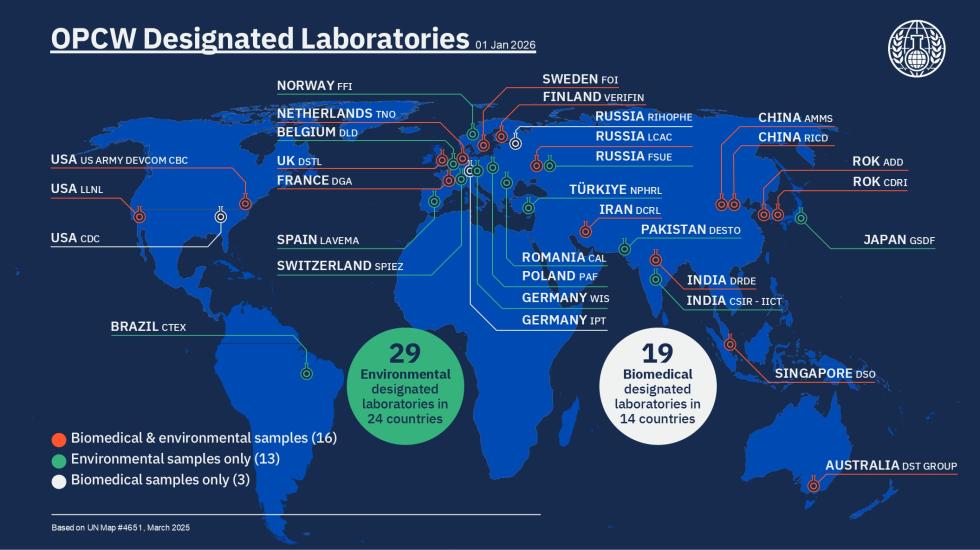
Together, they form a global network that delivers independent and reliable chemical analysis in support of the Organisation’s verification activities.
This network helps ensure that allegations of chemical weapons use are assessed using robust, impartial, and accurate scientific evidence.
The number and composition of OPCW designated laboratories worldwide change periodically, as designation is subject to rigorous accreditation and regular re-accreditation processes.
The OPCW does not publicly disclose which designated laboratories contribute to specific activities. All designated laboratories operate under strict confidentiality agreements, which safeguard the integrity, independence, and credibility of the analyses and results they provide.
When are designated laboratories involved?
When analysis of a sample is required, the OPCW can request support from its designated laboratories.
Their independent analyses help verify OPCW Member States’ declarations and clarify findings during investigations.
Designated laboratories can analyse samples collected during:
-
inspections at chemical production facilities
-
visits to storage depots and other installations
-
investigations of alleged chemical weapons use
-
Technical Assistance Visits
How can a laboratory obtain OPCW designation?
Only laboratories that meet strict accredited quality standards (usually ISO-17025) and pass regular OPCW proficiency tests can earn and retain designation status.
Becoming an OPCW designated laboratory requires sustained technical expertise, specialised infrastructure, and long-term investment. Laboratories must demonstrate their capabilities through a stringent proficiency testing programme covering:
-
sample processing
-
sample analysis
-
chain of custody
-
reporting criteria and procedures
The OPCW operates two types of designation, each with a dedicated proficiency testing scheme, both of which are carried out under ISO-17043 accreditation:
-
Environmental sample analysis
-
Biomedical sample analysis
Designation for biomedical sample analysis involves additional technical complexity, including more advanced and sensitive instrumentation, specialised analytical methods, and expertise in handling biological materials.
The time required to achieve OPCW designation varies, depending on a laboratory’s existing capabilities, experience in chemical analysis, and performance in proficiency testing. Each laboratory progresses through multiple testing stages, demonstrating consistent analytical quality before designation can be granted.
How does OPCW designation work?
OPCW designated laboratory status is open to any laboratory in any State Party to the Chemical Weapons Convention. The pathway to designation follows a structured process, with multiple entry points depending on a laboratory’s existing capabilities.
Laboratories typically begin with the Chemical Analysis Competency Test. This serves as an initial stepping stone, helping laboratories prepare for participation in OPCW’s Environmental Proficiency Testing or Biomedical Proficiency Testing.
Throughout the process, laboratories reach specific milestones, and the OPCW can provide targeted assistance at multiple points along the way.
How does the OPCW support laboratories to receive designation?
The OPCW supports laboratories working towards designation through targeted capacity-building activities and assistance tailored to each laboratory’s needs. The Organisation also oversees the Laboratory Assistance and Twinning Programme, which enables the exchange of personnel between paired laboratories for hands-on training and mentorship. Through this programme, the OPCW helps laboratories strengthen the infrastructure and expertise needed to achieve designation status.
What are the benefits for laboratories engaged in the OPCW designation process?
Laboratories that participate in the OPCW’s designation process benefit from the collective knowledge and experience of the Designated Laboratory Network.
Through this network, laboratories:
-
share best practices and analytical expertise
-
develop and exchange new methods and approaches to analysis
-
collaborate on research and technical innovation
-
Once designated, the status serves as a mark of quality, recognizing the laboratory’s strong analytical capabilities.
How can a laboratory maintain OPCW designation?
Designation is not permanent, and laboratories must continue to pass proficiency tests that meet OPCW standards.
If an OPCW designated laboratory performs unsuccessfully in a proficiency test:
-
its designation may be temporarily suspended, or
-
its designation status may be withdrawn
In such cases, the laboratory will no longer be eligible to be selected to receive and analyse authentic OPCW samples. It may, however, continue to support other OPCW-related activities as defined under applicable decisions.
This continuous evaluation process ensures that the OPCW Designated Laboratory Network remains reliable, credible, and fit for purpose, supporting the Organisation’s verification activities.