As the principal and plenary organ of the OPCW, the Conference of the States Parties oversees the implementation of the Chemical Weapons Convention, promotes its goals, and reviews compliance with the treaty. It also oversees the activities of the Executive Council and Technical Secretariat.
The Convention assigns the Conference several responsibilities including:
- taking measures necessary to ensure compliance with the Convention;
- adopting the programme and budget and deciding on the scale of the financial contributions to be paid by States Parties;
- approving the annual report of the Organisation;
- electing the members of the Executive Council;
- appointing the Director-General;
- fostering international cooperation for peaceful purposes in the field of chemical activities; and,
- reviewing scientific and technological developments that could affect the Convention.
Ensuring Compliance with the Convention
The Conference takes measures to ensure compliance by considering and adopting the Programme of Work of the Technical Secretariat. This Programme of Work determines the number of Article V (chemical weapons destruction) inspections as well as the number of Article VI (industrial) inspections that will take place each year.
The Conference decides upon the selection methodology used by the Technical Secretariat to determine which declared industries will be selected for inspection, and any changes to thresholds at which chemicals need to be declared.
The Conference also considers detailed reports from the Director-General on the progress being made by possessor States in their efforts to destroy declared stockpiles of chemical weapons, and reports on the conduct of industrial inspections carried out to verify declarations that have been made in accordance with the Convention.
While a State Party cannot be deprived of its membership of the OPCW, the Conference is authorised to take measures necessary to ensure compliance with the Convention. These measures include restriction or suspension of a State Party’s rights and privileges under the Convention; the recommendation to States Parties of collective punitive measures in conformity with international law and in cases of serious damage to the object and purpose of the Convention; and, in cases of particular gravity, bringing the issue to the United Nations General Assembly and the Security Council.
Regional Groups
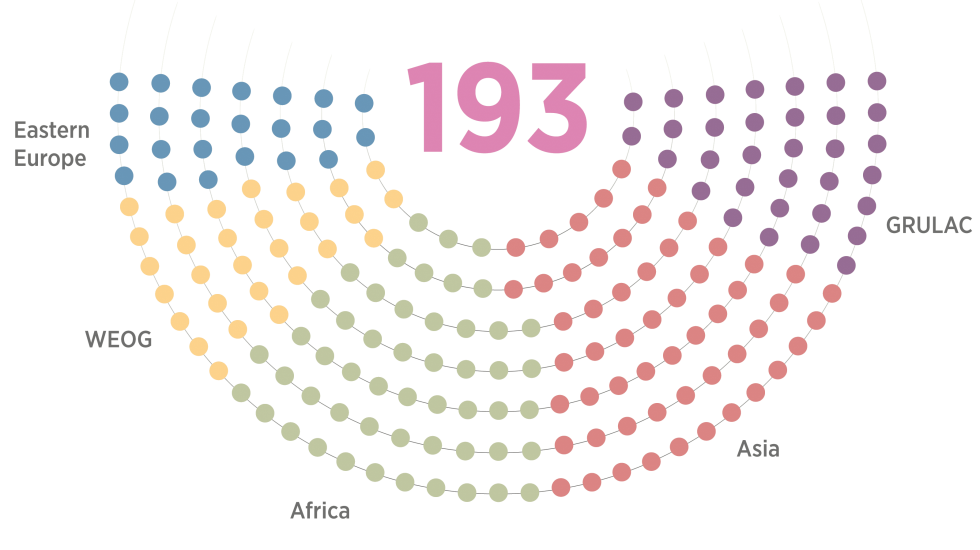
OPCW’s Member States are grouped into five geopolitical regional groups, which are used to determine the geographic representation of the Conference of the States Parties. The regional groups can also facilitate the coordination of strategic policy positions, and often form common fronts for negotiations and voting.
Decision Making
All States Parties to the Chemical Weapons Convention are automatically members of the OPCW, each with one vote.
The Conference takes decisions on questions of procedure by a simple majority of members present and voting. Substantive decisions should, if possible, be taken by consensus. If consensus is not attainable, a 24-hour period of deferment is called by the Chairperson of the Conference and every effort is made to facilitate consensus. If this procedure is not successful, the Conference may take a decision by a two-thirds majority of members present and voting. If the issue arises as to whether or not a question is one of substance, that question is to be treated as a matter of substance, unless the Conference decides otherwise by the majority required for decisions on matters of substance.
Committee of the Whole
The Committee of the Whole serves as the main forum for the discussion and consultation on substantive issues that may not yet be ripe for decision-making. The Committee strives to reach consensus on these issues and submits its recommendations to the Conference for subsequent action.
At each regular session, the Conference elects a Chairperson of the Committee of the Whole.
Credentials Committee
The Credentials Committee examines the credentials of all representatives to each Conference session. Pending approval by the Committee, representatives are entitled to participate provisionally in the session.
Any representative to whom another member of the OPCW has objected is seated provisionally with the same rights as other representatives until the Committee has reported, and the Conference has taken a decision on the objection.
The Credentials Committee consists of ten members, and is appointed at the beginning of each session of the Conference at the proposal of the Conference Chairperson.
Sessions and Meetings
The Conference of the States Parties meets annually for one week in The Hague.
Special sessions of the Conference can be convened under the following circumstances: when decided by the Conference itself, when requested by the Executive Council, or when requested by one third of all States Parties. In 2003, 2008 and 2013 and at five-yearly intervals thereafter, the Conference has convened special sessions to review the operation of the Convention. The Conference may also meet to consider proposed amendments to the Convention.
Non-Member States (Signatory and Non-Signatory) may attend regular sessions of the Conference as observers under certain conditions, and international and non-governmental organisations may also attend if invited by the Conference. At the beginning of each regular session, the Conference elects a new Chairperson and other officers, as needed, who will hold office until the next regular session.
Review Conference
The Review Conference occurs once every five years. It is an opportunity for all States Parties to review the operations of the Chemical Weapons Convention and set a strategic direction for the OPCW for the next five years and beyond. States Parties are anticipated to offer recommendations for enhancing the OPCW’s work in the areas of verification, assistance and protection, international cooperation, capacity development, and outreach.
The Review Conference will also present a vision of the Organisation’s internal reforms, aiming to ensure that the OPCW maintains its edge in a rapidly changing security environment, and can carry out the tasks States Parties confer upon it.